Buying a Rural Property – Common Oversights & Things To Consider

Buying rural property is about much more than checking boundaries and appreciating a nice view.

Whether you’re purchasing a farm, smallholding, equestrian property or a country estate, there are often hidden issues that can affect your enjoyment of the property, future plans, and even its value.

Rural property purchases often involve unique legal and practical issues that are not encountered in standard residential transactions. Asking the right questions at the outset can uncover risks, avoid disputes, and ensure that the property is suitable for your intended use.

Before buying a rural property, speak with our agriculture & rural property solicitors who are experts in rural property law.

buying a rural property or farm land

The enquiries buyers often forget when buying a rural property

Grazing Licences: More Than Just a Handshake

Grazing arrangements are common on rural properties and rarely as simple as they first appear. Local farmers, neighbouring landowners or equestrian businesses often graze livestock under informal, unwritten agreements — some seasonal, others in place for years as part of the property’s routine management.

Before you commit to purchasing a rural property, establish whether any grazing agreements exist and obtain copies of any written documentation. Identify who holds the right to use the land, when it expires, whether payments are made, and whether livestock will remain after completion.

Plans to farm, keep horses or develop the land immediately can be delayed by a third party’s ongoing right to occupy it.

Informal arrangements need particular scrutiny. A genuine grazing licence grants use of the land without creating an interest in it, but poorly drafted or long-running arrangements can inadvertently become a tenancy — giving the occupier greater security and making possession harder to recover than expected.

Grazing also affects day-to-day management. You should check who is responsible for fencing, water supplies, weed control, livestock and environmental compliance. Overgrazing can damage biodiversity projects and land conditions, whereas undergrazing can leave pasture unsuitable for its intended use.

Investigating any grazing arrangement tells you who holds rights over the land, what obligations attach to them, and whether you can use the property as intended from day one.

Our agricultural and farming solicitors regularly advise buyers of farms, equestrian properties, country estates, and development land. If you are considering purchasing a farm, country estate or development land and would like advice, please get in touch by contacting Anna Munro on 01672 518620 or complete our quick enquiry form below.

Law Society’s Conveyancing Quality Scheme (CQS)

Who Controls the Water?

Water is often one of the most valuable assets on a rural property, yet it is also one of the areas most likely to be overlooked.

A rural property may benefit from a private water supply, borehole, spring or reservoir. However, ownership of the land does not necessarily mean unrestricted rights to use the water. Rights may be subject to historic agreements, legal easements, environmental restrictions or abstraction licences that limit how much water can be taken and for what purpose.

You should also establish whether the supply is shared with neighbouring properties. It is not uncommon for farms, cottages and smallholdings to rely on private pipework that crosses third-

Accredited by the Law Society

party land or serves multiple properties. Where this is the case, it is important to understand who owns and maintains the pipes, how costs are shared and whether any necessary legal rights are documented.

An arrangement that has worked amicably for decades can quickly become problematic if relationships between neighbours deteriorate or a new neighbour arrives with different ideas.

A private water supply may require ongoing maintenance, regular testing, treatment equipment, or replacement of ageing pipework and pumps. A borehole that appears attractive during a viewing may not have sufficient capacity to support future farming operations, livestock enterprises or a full yard of horses.

Don’t Overlook What’s Beneath Your Feet

When viewing rural land, buyers are naturally drawn to what they can see, such as productive pasture, attractive arable fields or well-maintained paddocks. However, some of the most important features of a rural property lie beneath the surface.

Many farms and rural estates rely on extensive drainage networks that may have been installed decades ago. Land drains, ditches, culverts, soakaways and watercourses all perform a vital role in controlling water levels and keeping land productive throughout the year. If these systems fail or are poorly maintained, the consequences can be significant, affecting everything from crop yields and grazing capacity to access routes.

You should therefore make detailed enquiries about the drainage arrangements serving the property ask questions similar to the following:

  • Are there any known drainage plans?
  • Have drains been repaired, replaced or maintained in recent years?
  • Do any drainage systems cross neighbouring land, and if so, are there legal rights allowing water to discharge onto adjoining property or into nearby watercourses?

These rights are often overlooked but can be crucial if future maintenance or repairs are required.

Flooding should also be carefully investigated. While the property may appear dry and well-kept during a summer viewing, conditions can be very different during periods of prolonged rainfall.

Fields that are regularly waterlogged may be unsuitable for many crops or horse grazing. Access tracks can become impassable and buildings or barns may be at risk from surface water flooding or overflowing watercourses.

What Are The Neighbours Doing

When viewing a rural property on a bright summer afternoon, it is easy to focus on the property’s charm and distant rolling hills and overlook the activities taking place just beyond the boundary fence. However, neighbouring land uses can have a significant impact on both the enjoyment and future value of a rural property, making this an important area of enquiry.

One of the biggest surprises after completion is the reality of living or running your business alongside an active farm. Modern farming often involves regular crop spraying, fertiliser spreading, harvesting, muck spreading and the movement of large agricultural machinery.

These activities are an essential part of food production and may take place early in the morning, late into the evening, or during weekends and busy harvest periods when weather conditions dictate farming operations.

Attention should be paid to the potential for spray drift, where pesticides, herbicides or fertilisers applied to neighbouring land may drift beyond field boundaries. While many farmers take steps to minimise this risk, spray drift can be a concern if you are intending to keep horses, grow specialist crops, operate holiday accommodation or if a family member has breathing or health difficulties.

Understanding the nature and proximity of neighbouring agricultural operations can help you assess whether the surrounding environment is compatible with your intended use of the property.

It is also sensible to investigate whether adjoining land is subject to planning applications or diversification projects. Agricultural buildings can change over time, and neighbouring landowners may be exploring opportunities such as renewable energy developments, farm shops, glamping sites or event venues. While such developments can benefit the rural economy, they may also alter the character of the surrounding area.

A rural property rarely exists in isolation. Understanding how neighbouring land is used can help buyers make an informed decision, manage expectations and avoid unwelcome surprises after completion. After all, the perfect rural retreat may feel very different once crop sprayers and harvest machinery become part of everyday life.

Frequently Asked Questions

Do I need a specialist solicitor to buy a rural property?

A residential conveyancer can act on the purchase of a rural property, but the additional searches, unregistered title, and third-party rights discussed throughout this article are easy to miss without specific rural experience.

A solicitor who regularly acts on farms, smallholdings and country estates will know which searches to order, which enquiries to raise, and where the real risk in a rural transaction tends to sit.

Awdry law has a specialist team of rural property solicitors to help ensure your transaction is completed with as little stress as possible whilst ensuring that all checks are completed before moving forward.

What extra legal searches are carried out when buying rural property?

Alongside the standard local authority, environmental, and water and drainage searches used on a residential purchase, a rural transaction will usually also need a chancel repair search, a common land and town or village green search, a utilities search and, depending on location, a coal or other mining search.

A chancel repair search checks whether the property could be liable to contribute to the cost of repairing the chancel of a nearby parish church — a historic liability that can still attach to land today — while a common land search confirms whether any part of the property is registered as common land or a village green, which would restrict how it can be used and fenced.

What is the difference between a grazing licence and a farm business tenancy?

A grazing licence grants a right to graze livestock on land for a defined period without creating an interest in the land itself, so it is generally easier to bring to an end.

A farm business tenancy, by contrast, gives the tenant a legal interest in the land and considerably greater security, with formal notice requirements to end it.

Poorly drafted or long-running “licences” can sometimes be reinterpreted as tenancies, which is why the wording and conduct behind any grazing arrangement need careful review before you buy.

Do sporting rights automatically transfer when I buy rural property?

Not necessarily. Sporting rights, the right to shoot, fish or hunt over land — can be reserved to a previous owner, a neighbouring estate or a syndicate, and where that is the case they do not pass to you on completion.

It is important to establish what sporting rights exist and who holds them before you exchange, since rights reserved to someone else can be difficult, and sometimes impossible, to buy back afterwards.

Can a public right of way affect land even if I can't see one on site?

Yes. A right of way does not need to be obvious, or even signposted, to exist.

It may still be recorded on the local authority’s definitive map, and in some cases long-standing public use of a track can give rise to a right of way even where none has ever been formally recorded.

Checking the definitive map and raising specific enquiries before exchange is the only reliable way to establish what rights of way exist over the land.

What is a wayleave, and will I be paid for one?

A wayleave is an agreement allowing a utility company to install and maintain equipment — such as overhead lines, underground cables or pipes — on private land.

Many wayleaves come with an annual payment to the landowner, so if a property has wayleaves in place it is worth confirming what is paid, checking whether payments are up to date, and notifying the relevant utility company of the change of ownership so that future payments come to you.

How long does buying a rural property take compared to a standard house purchase?

Rural transactions generally take longer than a typical residential purchase because of the additional searches, third-party rights and unregistered title issues that often need to be resolved.

Timescales vary considerably depending on the complexity of the property, but building in extra time for these enquiries from the outset, rather than treating them as an afterthought, is usually what keeps a rural purchase on track.

Essential checks before buying a rural property

Grazing arrangements, water rights, drainage and neighbouring land use are the enquiries buyers most often forget, but they are not the only ones.

Rural transactions typically raise a wider set of practical and legal questions than a standard residential purchase, and it is worth working through them before exchange.

Before buying a rural property, you should consider the following areas:


The checklist below covers the areas that most commonly affect buyers of farms, smallholdings, equestrian yards and country estates.

Access Rights

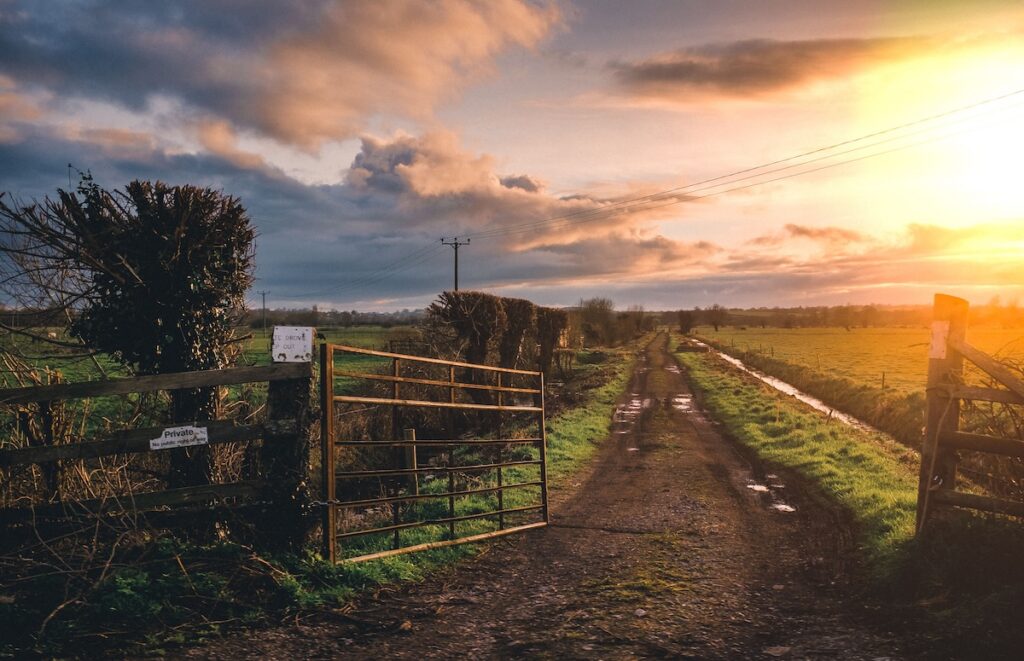
Not every farm, smallholding or country estate enjoys a straightforward, legally documented right of access. Long, unmade tracks, shared farm driveways and gated entrances leading off a quiet country lane are common across the countryside, and the right to use them is not always as secure as it first appears. Y

ou should establish whether the track running to the farmyard, stable block or paddocks is over land in the same ownership as the property, or whether it crosses third-party land under an easement, and if so, whether that easement is registered at the Land Registry, who is responsible for its maintenance and repair, and whether there is a formal cost-sharing arrangement with other users.

Where access runs over a private track shared with neighbouring farms, smallholdings or a handful of dwellings in a hamlet, it is also worth checking for any restrictions on vehicle type or use, such as limits on agricultural traffic, HGVs or commercial vehicles, which could affect farming operations, deliveries or future development.

It is also sensible to check whether any part of the access crosses a strip of land in separate ownership, sometimes referred to as a “ransom strip,” since whoever holds it can, in principle, demand payment before granting continued access or consenting to future development.

Boundaries

Boundary lines on a title plan are only ever a general indication of where a boundary runs, not a precise legal record, and rural land is particularly prone to a mismatch between the paper position and the position on the ground.

Hedgerows, fences, ditches and field gates are replaced and shifted over generations, and small parcels of grazing or woodland are sometimes added to or carved out of a holding informally, without the change ever being reflected in the title.

Before committing to a purchase, it is worth walking the boundary against the title plan or a recent aerial photograph, checking that the acreage being sold matches expectations, and establishing who has historically maintained each hedge, fence or ditch, since maintenance responsibility for a boundary is not automatically shared equally between neighbours.

If the physical boundary does not line up with the registered title, for example, a gap between the edge of a private track and the adopted public highway, then indemnity insurance may be available, and this is worth raising with your solicitor rather than assuming the discrepancy will resolve itself.

Water and drainage

Beyond the private water supplies and land drainage networks discussed above, buyers should confirm precisely how the farmhouse, farmyard and any outbuildings are connected for foul and surface water drainage, and whether this relies on mains drainage, a septic tank, a package treatment plant or a private sewage system.

Private drainage systems installed or altered since 2020 must comply with the General Binding Rules and may require registration or a permit from the Environment Agency, and older systems discharging to a watercourse can require upgrading on a sale.

Persistently waterlogged paddocks or grazing land can also be a sign of a drainage system that has never coped with the ground it serves, rather than simply an unusually wet season.

If a rurak property relies on a private water supply, it is worth checking whether the local authority has carried out risk assessments under the Private Water Supplies Regulations, as this can affect ongoing testing obligations for the new owner.

Rights of way

Rural land is frequently crossed by public footpaths, bridleways, byways or restricted byways threading between hedgerows and field boundaries, and these are quite different from the private easements discussed above because they grant a right of passage to the public at large, not just to specific neighbouring landowners.

Buyers should check the definitive rights of way map held by the local authority, ask whether any routes are proposed for diversion or extinguishment, and consider how a right of way crossing pasture, arable land or grazing paddocks might affect privacy, security, biosecurity for livestock, and any plans for fencing, building or landscaping.

It is also worth checking for any recorded but unrecognised routes, since historic use of a track by the public can sometimes give rise to a claim that a right of way exists even where none is formally recorded.

Sporting rights

It is easy to assume that the right to shoot, fish or hunt over rural land automatically transfers with the property, but sporting rights are often reserved to a previous owner, a neighbouring estate or a long-standing local syndicate, and can just as easily benefit the property over neighbouring land rather than the other way around.

When sporting rights have been reserved to someone else, they can be very difficult, and sometimes impossible, to buy back or bring to an end, since the person holding them has no obligation to give them up.

It is worth establishing exactly what sporting rights exist, who holds them, and on what terms, before exchange, particularly if shooting, fishing or hunting activity taking place on or near the land was part of the appeal of the property, or is something you would rather not have taking place over your own land.

Utilities and speed

Mains services cannot always be taken for granted on a farm, smallholding or country estate tucked away in the countryside, and the cost of connecting or upgrading them can be substantial.

Buyers should confirm how the farmhouse and any outbuildings, stables or barns are connected for electricity, gas and telecommunications, whether any of these services cross neighbouring farmland under a wayleave or easement, and who is responsible for maintaining cables, poles or substations serving the property.

Broadband and mobile signal are increasingly important, particularly for anyone running a business from home, managing a livery yard, or relying on the property for holiday letting, and it is sensible to check likely broadband speeds and mobile coverage before committing to a purchase, since satellite or fixed wireless solutions may be the only realistic options for a more remote rural setting.

If electricity is supplied via an overhead line or underground cable crossing third-party land, you should also check whether the wayleave is permanent or can be terminated, and what would happen to the supply if it were.

Where a wayleave is in place, it is worth checking whether the utility company pays an annual wayleave payment for the right to keep its equipment on the land, and ensuring the provider is notified of the change of ownership so that any future payments are redirected to you rather than the outgoing owner.

Property restrictions

Finally, buyers should check for restrictions that could limit what can be done with the farm, smallholding or estate in the future. These may include restrictive covenants affecting use or development, agricultural occupancy conditions or agricultural ties limiting who can live in a farmhouse or cottage, listed building status for a period farmhouse or historic barn, and location within a National Landscape (formerly an Area of Outstanding Natural Beauty), National Park or conservation area, each of which can bring additional planning controls over how the wider rural landscape may be used.

Rural land can also carry separate environmental and heritage designations, including status as a Site of Special Scientific Interest (SSSI), which restricts activities affecting the flora, fauna or geology of the land, or as a Scheduled Monument, where consent is required before repairs, fencing, planting or other ground works can be carried out — both bind a new owner automatically, whether or not they were flagged at the point of sale.

It is also worth checking whether the property benefits from, or is bound by, an overage or clawback provision requiring a share of any future development value to be paid to a previous owner, and whether any planning permissions, listed building consents or agricultural exemptions relied upon by the current owner were properly obtained and complied with.

How our agriculture & rural property solicitors can help

Our agricultural and rural property team regularly advise buyers of farms, equestrian properties, smallholdings, country estates, and development land. We know the questions to ask, the risks to look for, and how to help you proceed with confidence.

If you are considering purchasing a rural property, such as a farmhouse, country estate or development land and would like advice, please get in touch by contacting Anna Munro on 01672 518620 or complete our quick enquiry form below and we’ll get back to you promptly.

Quick enquiry.

This field is for validation purposes and should be left unchanged.
Name(Required)

News

Understanding Abusive Relationships with Narcissists: Key Signs and Insights

Understanding Abusive Relationships with Narcissists. In today’s blog post, we wanted to share some information about abusive relationships and the involvement of narcissism in them.
Awdry Law - Legal Solicitors in Bath, Chippenham, Devizes, Marlborough, Royal Wootton Bassett and Swindon.
Privacy Overview

This website uses cookies so that we can provide you with the best user experience possible. Cookie information is stored in your browser and performs functions such as recognising you when you return to our website and helping our team to understand which sections of the website you find most interesting and useful.